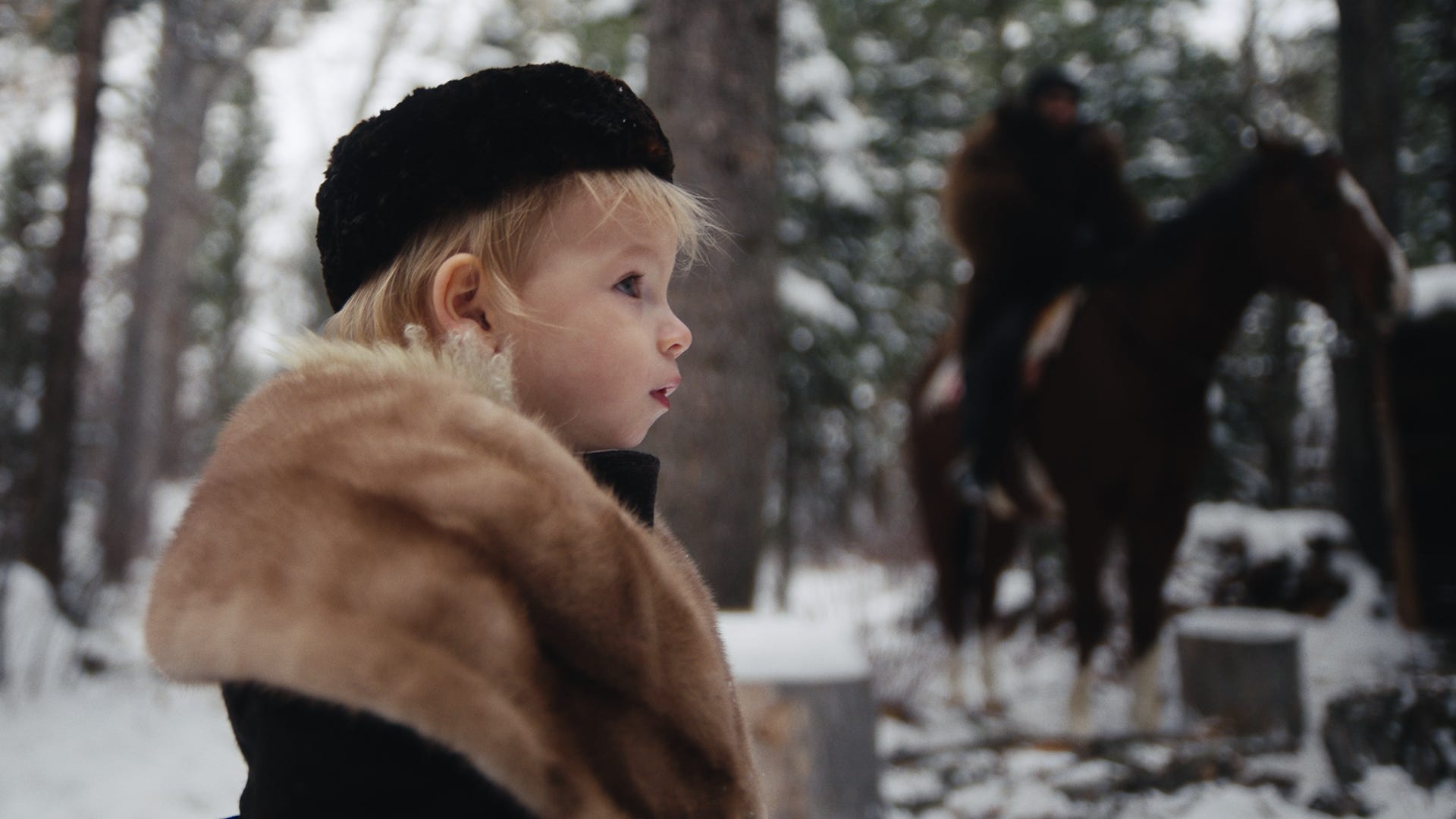
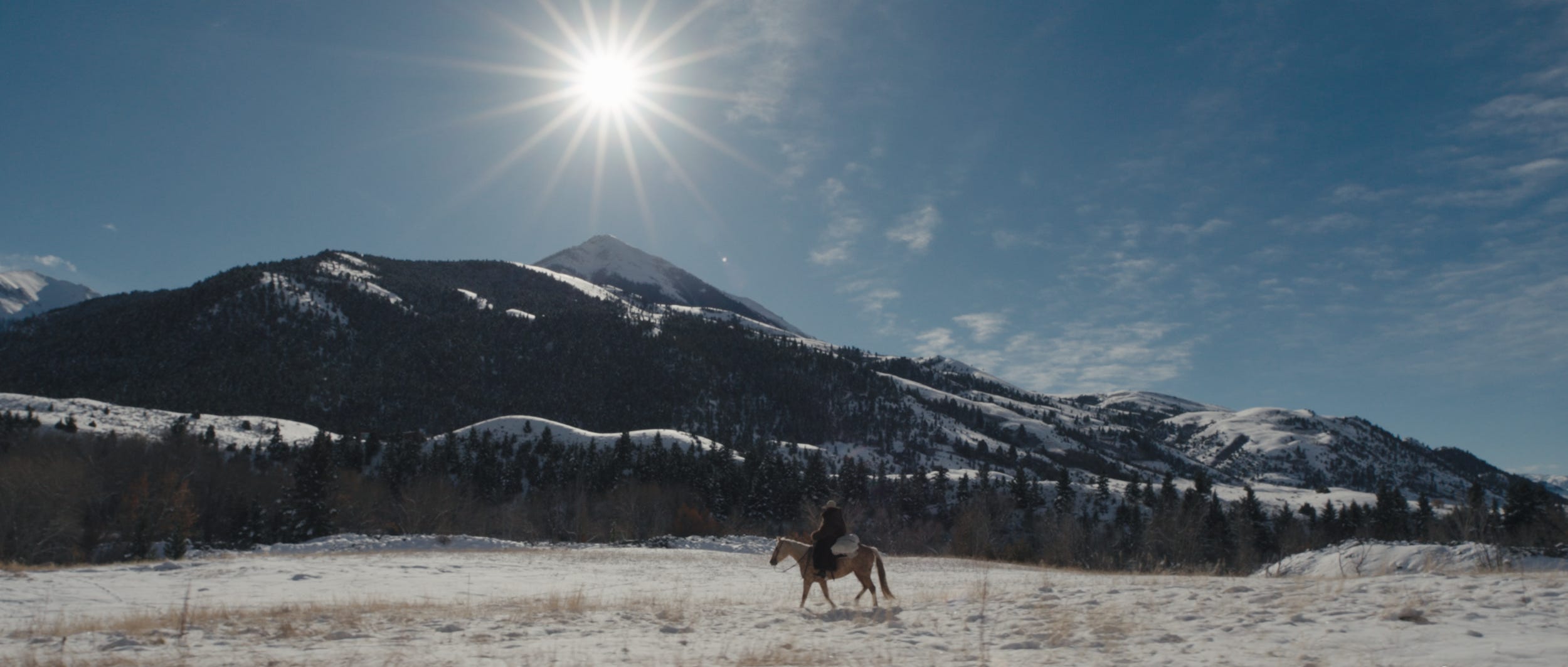
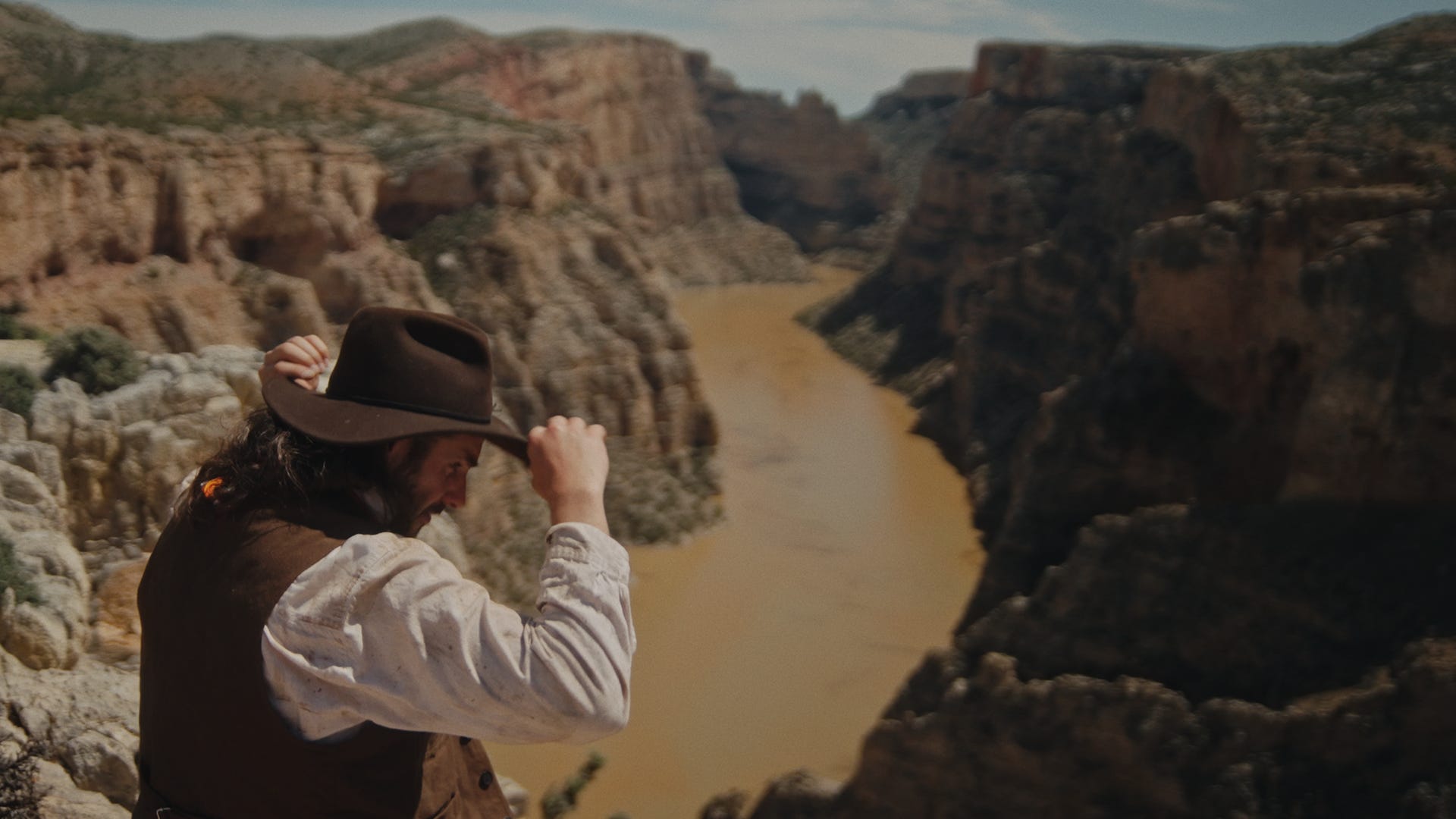
Synopsis:Eastern Western is the story of a son raised by two fathers, one from the European East and one from the American West, set on the cusp of the 20th century. Deep in the mountains of the American Frontier, Igor, an immigrant and recent widower, struggles to raise his two-year-old son Ivo in the harshness of winter. When Duncan, an American horse rancher and friendly acquaintance, decides to move his horse-breeding business and family to California, Igor and Ivo join the wagon train headed West. After a series of encounters with both friend and foe, Duncan is left with a decision that will affect the family’s future forever.
1.) Even though the main character is a man, the story is truly driven by a woman. Why was it important for you to make a female figure the heart of Eastern Western?
Marina: In our experience of our family’s immigration, which started in Bulgaria, a lot of the momentum came from our mother. Women have a good sense of the future, and they fight for the future they want – it’s in the female nature. In times of unrest, women are major catalysts of change, movement, migration. We decided that Igor’s wife would be his anchor and guiding force, and the bridge between East and West. His wife offers him a strong connection to his homeland, where their journey began, as well as to the future she wanted in America. Although she is physically absent from the story, her presence is always felt.
Biliana: We conceived Eastern Western as a father and son story because we were very much inspired by our longtime friend Igor Galijasevic and his real-life son, Leonardo. Igor’s path also led him from Eastern Europe to America, and as we were thinking about our first narrative film, what we wanted to say, who we wanted to cast, we very organically decided to approach him to be a part of this journey. We do hope, however, that when audiences watch Eastern Western, they might also question the idea of “main character.” This film, in our eyes, is truly delivered by an ensemble cast. It’s hard to say who the story belongs to, because it’s ultimately a story of interconnectedness.
2.) What advice would you give to emerging creators who want to tell personal or unconventional stories but aren’t sure where to start?
Marina: I would say follow the kernel of what excites you but challenge yourself with at least one major logistical aspect of your story, and let that help your story develop unconventionally, so to speak. For example, we chose to shoot almost entirely in the outdoors of Montana. It was the backdrop to our story, but also a major advantage to our narrative, as the characters move through these landscapes and the story develops. So what I mean is, assess your advantages and perhaps something less obvious will offer so much creative potential and exploration in the narrative. This way of working stems from our documentary background.
Biliana: To Marina’s point, work on maximizing your production value by curating everything on screen in a pragmatic way and stay flexible. You can’t point the camera in the wrong direction if you’re standing amidst the Montana wilderness. The vistas alone contribute to stunning imagery. We knew we wanted to make this film a period piece, but didn’t necessarily think of it as a Western at first. However, the choice came naturally. Imagine filming a period piece in the big city? Your budget skyrockets. Everything around you has to look the part: cars, buildings, extras wardrobe, etc. Whereas if you are in the middle of the prairie, a cabin and the wardrobe will get the job done.
3.) What did working together as a sister duo teach you about each other and your creative process?
Biliana: We have been working together as creative collaborators ever since I can remember, and we eventually made it official by starting our production company El Jinete Films in 2015. I think that over the years, we have learned a lot from each other. We have always worked as a team, and inevitably have become (I believe) better team players because of that dynamic. Filmmaking is a team sport. There is no room for egos, there is no room for “I,” and in our case it has just always been “we.”
Marina: We work to translate this sentiment on our sets. Creativity is all about communication, collaboration, and being a good listener. You have to trust each other and always know that two heads are better than one.
4.) How did your own experiences as immigrants shape the story, themes, or characters in Eastern Western?
Biliana: We always knew that our first narrative film had to be a “coming to America” story. We left Bulgaria at a very young age and primarily lived as outsiders in the many places we settled in. In the year 2000, we made the move to the United States, and ever since then, we have been discovering that America can either be a welcoming place, or a very harsh place, depending on many factors. Typically, the process of adjusting to a new land is easier for the children than it is for the parents, and this is one of the main themes we wanted to explore in Eastern Western. We also examine the connection to home, a home you might never see again, or a home you might never get to know in the first place. It was important for us to tell a generational story during a time when communication with the homeland was extremely difficult. We also chose the Western format because it’s essentially a genre as old as the medium of cinema, and it has clearly been lacking diverse perspectives. I recently came across a “Top 50 Westerns” of all time – 2 of them were directed by women, and needless to say the majority are not about women or any foreigners. We didn’t necessarily set out to buck any trends, but I am happy that the final result seems to be doing just that.
Marina: Being an immigrant is inherent to our identity as people, and therefore our identity and perspective as storytellers. This led us to tell a global story via a local perspective – of this immigrant father, and his son, and their journey in the American West. For me, immigration is the most telling experience of our global world – it is so specific to each person, but so universal. Therefore, everyone, in some capacity, has experienced or been witness to it. The history and development of the western frontier of America held so many immigrant stories that are not widely depicted in film, and so we decided to tell this story in the vastness of the American West. It does also serve as a representation of immigration at any point in history, because the struggles, relationships, emotions, and journeys of immigration are recurrent.
“Being an immigrant is inherent to our identity as people, and therefore our identity and perspective as storytellers.“
5.) What drew you to this story, and what do you hope audiences take away from it?
Marina: What drew us to this story was the ability to explore foundational relationships, between people, between people and animals, and between people and nature, during a pivotal span of time in the history of America. Through a very specific lens, we explore reasons and consequences of migration from many different angles, that of an Eastern European, an American family, a Native American, and even the forced migration of thousands of horses during wartime. We hope audiences can appreciate the levels of sacrifice that exist within the dynamics of these relationships.
Biliana: I hope there is something within this story for everyone to discover and connect with. As Marina says, this film is about characters from many different walks of life. I hope we were able to showcase that individual empathy can go a long way, and if we have the ability to help our fellow neighbor, human or animal, we should do so.
“I hope we were able to showcase that individual empathy can go a long way, and if we have the ability to help our fellow neighbor, human or animal, we should do so.“
Emanuel (Kataem O’Connor) and Dawn (Milcania Diaz-Rojas) – 40 Acres (Source; Magnolia Pictures)
Q&A WITH MILCANIA DIAZ-ROJAS X 40 ACRES
August 12, 2025
WIF spoke with actress Milcania Diaz-Rojas about her role as “Dawn” in the feature film 40 Acres. This sci-fi thriller tells the story of a Black family of Canadian farmers descended from American Civil War migrants as they defend their homestead in a post-apocalyptic world.
You play Dawn, a wanderer who enters the isolated Freeman family’s world. How did you approach developing her identity and motivations within this post-apocalyptic setting?
During the audition process I was already forming a sense of who Dawn was—her energy, grit and drive. After getting a chance to read the full script and of course falling in love with the story and world I started to see how Dawn fit into the bigger picture, which gave me the clarity I needed to approach her in a way that I thought would best serve the narrative and for me that meant truly understanding her motivation behind her choices.
Dawn is all about her family and community, and in this post-apocalyptic world, especially as a nurse, her survival instincts, her guardedness, but also the motherly instinct that she takes on is the driving force behind her choices—all of that was rooted in my experiences, during and after COVID-19, when spending time with family was a privilege and survival mode had peaked, but also from what I know about being a mother, it is a superhuman instinct to protect your kids.
As you follow the story of the family- in walks this intruder and my job as Dawn is simply surviving, giving her the reasons to make the decisions she has made, to have that internal conflict with this new connection she has made with Mannie and also that survival and maternal instinct of protecting her own without revealing anything prematurely.
No one sees themselves as a villain in life, and I made sure Dawn had strong motivations behind everything she did. Director R.T. Thorne said it best, “no one is really in the wrong,” however what everyone is driven by is a completely different thing, some survival and protecting their land and immediate family, others by each other in community. Asking myself these questions about Dawn helped create the most genuine relationships within the characters world.
40 Acres draws parallels between survival in a dystopian world and preserving cultural legacies. As a Latina, how do you connect with Dawn’s sense of survival and belonging?
As a first generation Canadian who grew up in a Spanish speaking household, eating traditional Dominican dishes like Sancocho, Arroz con habichuelas y pollo guisado (rice with beans and stewed chicken), and mangú con plátano frito (mashed plantain and fried salami), I am a mixture of African, Spaniard, indigenous roots in a perfect harmony. I think it has been such a blessing to be able to say these things have been carried down and my full intention is to carry it on with my daughter.
It wasn’t until a several years ago, I was working as a stand-in on a show and had a conversation with Eva Longoria who asked, ”Why did your family end up coming to Canada of all places?” And when all I could say was “I don’t know.” Her response was “You should find out—it’s important” stuck with me. I began to wonder for myself, why Canada? When I asked my grandfather, I found out that back in Dominican-Republic he worked as an accountant at a firm, that was unfortunately run by some corrupt people. My grandfather as an honest and God-fearing man was not willing to do what he was being asked- the same people ended up on one occasion kidnapping him with some of his children and threatening him (thankfully, no one was hurt). So, he came here as a refugee in 1989 fleeing for his and his family’s safety. My mom then came in 1991 and my dad followed in 1992.
Moving your whole family to an unknown land, where a different language is spoken, having to start from ground zero and yet still preserving cultural legacies. This is the same story as the Freeman family, a family that immigrated to Canada and worked their butts off to have this legacy and farmland to pass down, and in this blended family an indigenous father who may not have immigrated, but continues to preserve family legacies and indigenous roots through, language, traditions, food- passing it down through their children.
I am continuing the same way it was passed onto me, preserving languages, recipes, music, stories—so my daughter can understand her roots and have the same pride and gratitude for all she has, understanding that it’s a privilege to have what we now have.
The Freemans are descendants of African American farmers who escaped to Canada. How did understanding this history help you shape Dawn’s interactions with the family?
My approach to Dawn wasn’t based on them being African American and Indigenous farmers, but it did give me a greater respect and understanding of the story being told. My character does not come into the picture until after the family dynamic is already established, so most of my interactions begin and exist between Mannie who is played by Kataem O’Connor and myself.
Of course, my character eventually has an explosive first interaction with Haley Freeman and Galen (played by powerhouses Danielle Deadwyler and Michael Greyeyes). In that scene there is a clear depiction of the power dynamic between my character and theirs, the strength they hold as they tower over me at gunpoint clearly reveals a world where they’ve had to fight for survival, and that’s true of what both of our communities have had to overcome, and I think the film does a great job of hinting at that.
In a genre space historically dominated by white male perspectives, what does it mean for you as a Latina woman to be part of a primarily Black-led post-apocalyptic thriller?
As an Afro-Latina woman it’s an honor to be part of a film with such a rich story and to get the opportunity to bring Dawn to life, and its a breath of fresh air to be part of a project spotlighting a mixed race family of Black and indigenous roots. These two cultures that have already suffered an apocalypse and that have had to fight to preserve their cultures and traditions. Being from Dominican-Republic, a country where our indigenous peoples ‘The Taino People’ —who inhabited Cuba, Jamaica, Hispaniola (also known as Dominican-Republic and Haiti), and Puerto Rico, were almost completely brought to extinction thanks primarily to Christopher Columbus and Spanish colonialism. The island led by Christopher Columbus became the first place where a large scale of enslaved Africans were sent to replace the Taino peoples who had been damn-near obliterated.
My history as a Latina woman is deeply rooted in the same traumas that African-American and indigenous communities from North America have had to endure, being able to play a part in telling this story of 40 Acres that sheds light on these themes while still delivering everything you want in an action packed post-apocalyptic thriller.
I am proud to be part of this as a Black woman, and as a Latina woman im incredibly proud to represent, because there is still work that needs to be done in having afro-Latino representation on screen. Growing up watching Hispanic telenovelas—there was rarely ever the representation I would have wanted to see, the people and women who looked like me and who spoke the same language I spoke at home. As a woman of color who is also Latina it is incredibly important for me to represent not only my black roots, but my Latin roots and show all the little girls who look like me how possible it is, the same way seeing Zoe Saldaña on Colombiana and seeing another Dominican Afro-Latina woman leading a kick-ass film inspired me.
What challenges—on-set or in the industry—have you faced as a Latina actor, and how have you worked to overcome them?
Getting your foot in is always the hardest part, like anything else. Getting that opportunity to showcase what you can do as an artist, but all you can continue to do is continue to do the work necessary, honing in on your craft as an artist and creating other avenues to be prepared for when opportunity comes- or break down doors and create them yourself. Being cast in “Latina” roles themselves has been a challenge, like I mentioned earlier, there is still a lack of Afro-Latino representation on screen, so creating the opportunities for myself, to show what I can do has been my avenue. Making short films where my character is Spanish speaking, or bilingual, sprinkling it in any chance I get and collaborating with other Latino creatives in the city to forge my own path.
Finally, what does success look like for you, not just personally, but for the kinds of stories you want to champion in the industry?
For me, success is about being part of stories that matter. I want to champion work that moves people, stories rooted in truth, faith, culture, and the beauty of who we are—not just our traumas, but our resilience, joy, and depth. As an Afro-Latina woman, I want to see our stories told honestly and powerfully.
Personally, success means creating a life with balance—where I can be present for my daughter, lead with purpose, and no longer rely on side jobs to get by. I want to work consistently on projects that reflect my faith, my culture, and my heart—and leave behind a legacy she can be proud of. Ultimately, success is living in alignment with what I value, creating meaningful art, and inspiring my daughter—and others—to believe they can do the same.
Watch the trailer for 40 Acres, playing in theaters nationwide.
It’s safe to say that everyone has had a very long and trying pandemic. The film and television industry is no exception, as you all know. Everyone had to rally to make their departments compliant with the ever-changing on-set COVID rules. This gave Earth Angel the opportunity to collect new tricks of the production sustainability trade while continuously adapting to the “new normal.” Here are our top five tips on how you can do the same:
5 On-Set Sustainability Tips in the Time of COVID-19
Avoid Single-Use Plastic Water Bottles While one of our top priorities is always to avoid single-use plastic, we had to rethink our approach to ensure that keeping hydrated is also pandemic-safe.
The first option is to use touchless water dispensers. After you advise your cast and crew to bring their reusable water bottles, everyone can use these dispensers to hydrate sustainably and keep their germs to themselves! We recommend Avalon or the WaterMonster hands-free dispensing kit.
Another option when you really need a single-use alternative is to always have Mananalu Water available on set. It comes in aluminum bottles that are infinitely recyclable, rather than petroleum-based plastics (yuck)!
Have a Foolproof PPE Recycling Set-Up In order to avoid the cast and crew’s instincts to throw out their PPE in the general trash when they switch it out or when they’re off for the day, put labeled PPE recycling bins at every waste station and ship your PPE waste to TerraCycle. You won’t regret putting extra time in now to save a lot of waste later.
Green Your Lunch
You can order in! Companies like Deliver Zero and Jybe partner with restaurants prioritizing eco-friendly materials. Yes, please!
Another part of the “new normal” is not being able to eat together. But reusable dishware is still very much a safe and sustainable option, even in a pandemic! Unless explicitly marked sterile, disposable items inevitably have a certain level of bacterial contamination from passing through so many different hands. Disposable items are also more likely to be contaminated from a stranger’s cough than something you already own.
If you do need disposable to-go containers for cast and crew, you’ll want to make sure that the containers are compostable and made out of fiber and bamboo. This is a surefire way to create a low impact lunch on set!
Use Electric Generators By using an e-generator instead of a typical one, you’re not only reducing your carbon footprint, but you are also creating a safer space that is helping slow the spread of COVID-19. Since they generate electricity from battery storage rather than burning diesel fuel, this alone increases the surrounding air quality. COVID-19 rates are proven to be higher in places with poor air quality. This is another great way that productions can do their part to help end the pandemic.
Go Paperless! We, of course, always recommend going paperless—for obvious reasons—but it’s even more convenient during these times. Here are some great options to avoid wasting paper and spreading germs:
Scriptation is known for having useful tools and features for every production department. Whether you need to annotate scripts or do a file dump, it always comes in handy.
ProductionPro is a great program to use for production collaboration that keeps everyone updated of script changes, schedule changes, and plenty more. There’s nothing better than having an update right in front of you instead of doing yet another re-print.
TiM, a.k.a. Time is Money, is a program that will do a 180 to your crew onboarding paperwork process. Incredible! It comes with preexisting templates for your start paperwork (don’t worry—you can customize your own, too), you can speed up your approval pipeline, you’re able to track the status of everyone’s paperwork in one place, and many more time-saving features.
Now that you have more tools under your belt to improve your on-set sustainability, you can put them to good use and continue to help drive their importance on all of your productions.
Watch our Speaker Series panel on sustainable filmmaking, featuring Earth Angel’s Emellie O’Brien, Tandem Pictures CEO Julie Christeas, and Audrey Vinant-Tang, Senior Manager, Global Sourcing—Energy, ViacomCBS.
See environmental activist Jane Fonda‘s speech as she received the inaugural Jane Fonda Humanitarian Award at the 2021 WIF Honors, presented to her by RuPaul Charles.
This International Women’s Day, WIF once again encourages you to take on the #52FilmsByWomen challenge. Introduced a few years ago, the basic rules are simple: watch 52 films directed by women within the course of one year. Share about the films you’re watching on social media, using the hashtag #52FilmsByWomen to spread the word, and get more people talking about the women filmmakers that don’t always get attention. You can even browse cinephiles’ lists that they’ve made on Letterboxd, and create your own! Here’s a sample schedule you could follow to watch #52FilmsByWomen before International Women’s Day 2023—this list includes new releases, notable anniversaries, and recent films you may have missed. Let us know what’s on your list on Twitter and Instagram!
Turning Red, directed by Domee Shi The first Pixar feature to have a woman holding sole directing credit, this animated film about a Chinese-Canadian teenager who transforms into a giant red panda during puberty debuts on Disney+ on March 11, 2022.
Rescued by Ruby, directed by Katt Shea This family-friendly feature debuts on Netflix on March 17, 2022.
Alice, directed by Krystin Ver Linden Debuting in the U.S. Dramatic Competition at this year’s Sundance Film Festival, this shocking feature inspired by true events stars Keke Palmer as a woman who escapes slavery to discover that the year is 1973. A theatrical release is scheduled for March 18, 2022.
Cheaper by the Dozen, directed by Gail Lerner A new take on the family favorite starring Gabrielle Union, this film debuts on Disney+ on March 18, 2022.
Master, directed by Mariama Diallo Another star of the U.S. Dramatic Competition at Sundance, this insidious academia-set film stars Regina Hall and debuts on Prime Video on March 18, 2022.
Umma, directed by Iris K. Shim This supernatural horror film boasts Sandra Oh as its star and Sam Raimi as one of its producers, and opens theatrically on March 18, 2022.
Mothering Sunday, directed by Eva Husson Based on the novel set in the aftermath of World War I, this film which premiered at Cannes in 2021 will have a limited theatrical release on March 25, 2022.
Along for the Ride, directed by Sofia Alvarez This romantic teen drama based on the novel by Sarah Dessen debuts on Netflix on April 22, 2022.
Petite Maman, directed by Céline Sciamma This festival favorite French film about a young girl’s grieving process opens theatrically in the U.S. on April 22, 2022.
Hatching (a.k.a. Pahanhautoja), directed by Hanna Bergholm This Finnish horror film about a young gymnast with a demanding mother debuted in the MIDNIGHT section at Sundance, and will open in theaters and on VOD on April 29, 2022.
Happening (a.k.a. L’événement), directed by Audrey Diwan Winner of the Golden Lion at the 2021 Venice International Film Festival, this film takes place in 1960s France when abortions were illegal. It is scheduled to open theatrically on May 6, 2022.
Cléo from 5 to 7 (a.k.a. Cléo de 5 à 7), directed by Agnès Varda (1962) This French New Wave classic celebrates the 60th anniversary of its Cannes Film Festival debut on May 10, 2022. It is available to stream on HBO Max.
Saving Face, directed by Alice Wu (2004) In May, which is observed as Asian Pacific American Heritage Month, there are many excellent films from Asian American women directors to include in your film canon. Streaming on Prime Video, this film tells the story of a mother and daughter balancing secrets with tradition.
Shirkers, directed by Sandi Tan (2018) In case you missed this unconventional documentary, take this opportunity to stream it on Netflix. Watch the film about Tan’s own time spent making a film in Singapore in 1992, then check out her latest novel, Lurkers.
Watcher, directed by Chloe Okuno This thriller that premiered in the U.S. Dramatic Competition at this year’s Sundance will be distributed theatrically and on Shudder on June 3, 2022.
Neptune Frost, directed by Anisia Uzeyman & Saul Williams Featured in the Spotlight section at Sundance, this Afrofuturist sci-fi musical with an anticipated June 3, 2022 release date.
Miss Juneteenth, directed by Channing Godfrey Peoples (2020) An emotional mother-daughter story centered around a beauty pageant and women’s resilience; streaming on BET+.
Desert Hearts, directed by Donna Deitch (1985) Celebrate Pride Month in June by watching one of the first films ever to have a wide release which positively portrays lesbian characters and relationships. Streaming on HBO Max.
A League of Their Own, directed by Penny Marshall (1992) On July 1st, celebrate the 30th anniversary of this women’s sports classic starring Geena Davis and Lori Petty; streaming on Peacock.
Crip Camp, directed by Nicole Newnham & James Lebrecht (2020) Disability Pride Month is celebrated in July, marking the anniversary of the passage of the Americans with Disabilities Act (ADA) in 1990. Watch this documentary on Netflix about how disability rights advocates fought for civil rights legislation.
City of God (a.k.a. Cidade de Deus), directed by Kátia Lund & Fernando Meirelles (2002) This Brazilian crime drama turns 20 this year, and is widely critically acclaimed as one of the best films of the 21st Century. Stream it on HBO Max.
Where the Crawdads Sing, directed by Olivia Newman Based on the best-selling novel by Delia Owens, this drama starring Normal People‘s Daisy Edgar-Jones opens theatrically on July 22, 2022.
CinemAbility: The Art of Inclusion, directed by Jenni Gold (2012) Released 10 years ago on the anniversary of the ADA, this documentary explores portrayals of disability onscreen, and is available to watch on Tubi.
Luck, directed by Peggy Holmes Jane Fonda and Whoopi Goldberg star as voice talent in this original animated feature debuting on Apple TV+ on August 5, 2022.
Fast Times at Ridgemont High, directed by Amy Heckerling (1982) This icon of coming-of-age teen movies turns 40 on August 13. Stream it on AMC +.
Margarita with a Straw, directed by Shonali Bose (2014) This Hindi-language film follows an Indian teenager with cerebral palsy navigating relationships and an understanding of her sexuality. Streaming on Tubi.
The Bride, directed by Jessica M. Thompson A gothic horror starring Nathalie Emmanuel, opening theatrically on August 26, 2022.
Harlan County, USA, directed by Barbara Kopple (1976) Acknowledge Labor Day with a landmark documentary about a coal miner strike in rural Kentucky that lasts over a year. Streaming on HBO Max.
Honk for Jesus. Save Your Soul. directed by Adamma Ebo Featured in the Premieres section of Sundance, this film stars Regina Hall as the first lady of a Southern Baptist church in the aftermath of a scandal. A theatrical and same-day Peacock release is scheduled for September 2, 2022.
Eve’s Bayou, directed by Kasi Lemmons (1997) This southern gothic drama, which turns 25 on November 7, has been selected by the Library of Congress for preservation in the National Film Registry. It is currently streaming on Tubi.
Whale Rider, directed by Niki Caro (2002) First debuting 20 years ago at the Toronto International Film Festival on September 9, 2002, this story of a young Māori girl’s quest to become the chief of her tribe, despite her gender. The film is available to rent.
The Woman King, directed by Gina Prince-Bythewood This anticipated historical epic starring Viola Davis as the warrior general of an African kingdom. It is set to open theatrically on September 16, 2022.
Don’t Worry, Darling, directed by Olivia Wilde Florence Pugh stars in this upcoming psychological thriller set in the 1950s, opening theatrically on September 23, 2022.
Portrait of Jason, directed by Shirley Clarke (1967) This avant-garde, cinéma vérité documentary profiling an enigmatic performer has also been preserved in the National Film Registry. It turns 55 on October 2, and can be viewed on The Criterion Channel.
Near Dark, directed by Kathryn Bigelow (1987) On October 3, this vampire horror-noir turns 35; it’s available to stream on MovieSphere.
LaDonna Harris: Indian 101, directed by Julianna Brannum (2014) This chronicle of Harris, a Comanche activist and civil rights leader, is told by a Comanche filmmaker—perfect to watch Native stories told by Native voices on Indigenous Peoples Day. It is available to rent.
Patu! directed by Merata Mita (1983) A documentary about anti-Apartheid protests directed by Māori filmmaker Mita, this film can be viewed online at NZ On Screen. Mita’s son Heperi Mita documented her work and impact in the film Merata: How Mum Decolonised the Screen, which is on Netflix.
I Like it Like That, directed by Darnell Martin (1994) The first film produced by a major film studio to be helmed by an African-American woman director, this Bronx-set film about Afro-Latino characters is available to rent.
Real Women Have Curves, directed by Patricia Cardoso (2002) This film adaptation of the stage play turns 20 years old on Novemeber 8, and features the debut of actor America Ferrera. It’s streaming on HBO Max.
Spellbound, directed by Vicky Jenson This animated coming-of-age tale is set to debut on Apple TV+ on November 11, 2022.
She Said, directed by Maria Schrader Zoe Kazan and Carey Mulligan star as The New York Times journalists Jodi Kantor and Megan Twohey who broke the story of Harvey Weinstein’s sexual abuses. It opens theatrically on November 18, 2022.
Trudell, directed by Heather Rae (2005) Learn about American Indian poet and activist John Trudell in this documentary from Cherokee filmmaker Rae, which is streaming on IMDbTV.
Lingua Franca, directed by Isabel Sandoval (2019) Sandoval wrote, directed, and stars in this film about an undocumented Filipina trans woman working as a caregiver in Brooklyn. Streaming on Netflix.
I Wanna Dance with Somebody, directed by Kasi Lemmons Naomi Ackie stars as Whitney Houston in this upcoming biopic releasing on December 21, 2022.
In Between Days (a.k.a. 방황의 날들), directed by So Yong Kim (2007) A perfect watch for a winter’s day, this coming-of-age film centers a teenage Korean immigrant adjusting to her new surroundings in Canada. It is available to rent.
Selma, directed by Ava DuVernay (2014) A triumph of biographical narrative filmmaking, revisit this film on Martin Luther King Jr. Day in January. It’s available to stream on Paramount+.
Ruby Bridges, directed by Euzhan Palcy (1998) The 25th anniversary of this television film’s debut falls on January 18, 2023. Streaming on Disney+.
The Divine Order (a.k.a. Die göttiche Ordnung), directed by Petra Biondina Volpe (2017) Learn about women’s fight for the right to vote in 1971 Switzerland from this comedy-drama, available to rent.
Lionheart, directed by Genevieve Nnaji (2018) Nnaji herself stars in this film, the first Netflix original film produced in Nigeria.
The Seashell and the Clergyman (a.k.a La Coquille et le clergyman), directed by Germaine Dulac (1928) This surrealist experimental French film celebrates its 95th anniversary on February 9, 2023. It is available to watch on YouTube (see below).
The Marvels, directed by Nia DaCosta MCU characters Captain Marvel, Ms. Marvel, and Monica Rambeau return in this installment of the superhero franchise, opening theatrically on February 17, 2023.
The Hitch-Hiker, directed by Ida Lupino (1953) March 2023 marks the 70th anniversary of this film noir classic, streaming on Prime Video.
I joined WIF as a Help Line Advocate in 2019, a year after getting my Master of Social Work degree. At that point in my life, I wasn’t sure if I wanted to be a therapist, a community organizer, or leave social work altogether to go into human resources. But when I came across the job posting for the WIF Help Line, I was intrigued. As I was still recovering from my own experience of harassment and discrimination in the workplace, I felt called to use my advocacy and social work skills to support the film and television community. I come from an entertainment family and know the challenges of trying to make it in the industry. I felt that with my personal and professional experience, I could support the WIF community in a meaningful way.
As a Help Line Advocate, I answer calls from people in the industry who are seeking support and referrals after experiencing sexual harassment and/or assault. Through this work, I learned that I had to be there for our callers in a way that was respectful of their own individual processes, which are so much more complicated and nuanced than the discussions that were being had in our society as the “Me Too” movement took off. Access to legal support can be important for a survivor or victim of workplace sexual harassment or assault, but it doesn’t address all of the ramifications of working in abusive and toxic environments. Callers share the deep emotional impact that their experiences have had on their sense of identity and the difficulty of being excluded and overlooked in a male dominated industry. Nearly every caller expresses a desire to change the industry culture, and a hope that others will never have to endure a similar experience.
There is strength in numbers, but only if those numbers form a community. I realized that we needed a place for WIF members and Help Line callers to come together and share the knowledge that we are not alone in our experiences of discrimination and abuse. WIF had already sponsored support groups for industry survivors through our partner organization, Wright Institute of Los Angeles (WILA), but the pandemic made it impossible to conduct support groups like we had in the past. We realized that we could go virtual. As a social worker with past experience leading group therapy, and experience as an anti-racist and social justice organizer, I realized I was in the right place at the right time.
Over the past year and a half I have led three Black Member Support Spaces, which focused on healing from racial trauma, two Coping in Quarantine Support Spaces, which focused on coping with personal and professional stressors during the isolation of the pandemic, and the Survivors in Community Support Space, wrapping this month, with survivors of sexual harassment and assault in the entertainment industry. So often in these groups, one member describes their feelings and everyone else emphatically jumps in with “me too.” In a way, this space is a deepened, more healing continuance of the “me too” dialogues that happened on Twitter and elsewhere on the internet.
In these spaces, we often have discussions about loss of trust, including loss of trust in colleagues, friends and family, and the system at large. But as the groups go on, week by week, members begin to heal that loss by building trusting relationships with each other. Members also share and shape their self-care journeys. Just last week in our Survivors in Community Support Space, we discussed non-traditional self-care activities and we got onto the topic how healing dancing can be. I left the session inspired and spent 15 minutes dancing alone in my living room. Next week, we plan on dancing together with our cameras off. Each session looks different, but every discussion is about figuring out members’ needs and how to meet them.
If you want to challenge isolation, connect to your voice, and build community, join the next Survivors in Community Support Space, starting in March. It is an 8-week group for women and non-binary workers who have experienced sexual harassment, assault, and misconduct in the screen industries. The group is limited to eight people so that we can give space to each member’s story. To find out more, please fill out the interest form. I look forward to hearing your story.
Ashley Merriman Help Line Advocate and Support Space Facilitator
We, the undersigned, support the protection of workers and their rights to safe workplaces, reasonable work hours and rest, and living wages. As advocates of people underrepresented and under-protected in the entertainment industry, it is imperative that we uphold safe and regenerative working conditions, especially as we all continue to weather the strain of the COVID-19 pandemic.
We encourage anyone who considers themselves a champion for representation and justice to stand with us in support of Hollywood crew members. Read and sign on to IATSE’s petition for a fair deal, and continue to support organizations fighting to make our industry safer for all people.
Really Love, the new feature from director Angel Kristi Williams and co-writer Felicia Pride is a gorgeous evocation of the richness of Black love, culture, and urban life, via the story of Isaiah (Kofi Siriboe, “Queen Sugar”), a struggling artist, and the enchanting woman who changes his life, Stevie (Yootha Wong-Loi-Sing, THE PARADISE SUITE). Set in a gentrifying Washington, D.C., the film offers an incredible tapestry of music and art, from visual artists like Meleko Mokgosi and Chanel Compton to the songs of Ari Lennox and Kamasi Washington.
Read on for our interview with Williams, in which she discusses working with her director of photography on the color theory that informed the film’s palette, explains her process for connecting with her cast and crew on a story, and shares the Spotify playlist that kept her inspired during her creative journey.
This interview has been edited for clarity and length.
WIF: You’ve shared that this story had been with you for a long time, since you were—I think—seventeen. What was it, exactly, that you were most interested in capturing in this story?
Angel Kristi Williams: Yeah, well, I mean, one thing that I’ll say is that Felicia brought this love story to me. But my first experience with love was at the age of 17. So, what was important to me when Felicia and I decided to collaborate was, I sort of grew into that process. I had to become comfortable with being vulnerable enough to allow my own experience with love to be a part of the story. And once I fully allowed that to happen, that’s when the film got financing, that’s when I found my actors. That’s when, you know, everything just began to fall into place. But, you know, I think artists tell very personal stories, [but] there’s a wall that—especially when it’s about love and heartbreak—you don’t want to, you know, sort of put your business on front street.
But I learned that not being willing to do that was blocking the film and my process. And so the film really broke me open in some of the best ways. I walked away from production feeling like a new woman. What was important to me is to just show, like, Black people living and breathing and working and creating. And there’s no trauma; they’re just tying the space that they’ve created for themselves, that they feel facing. That, for me, was the most important.
WIF: What sorts of things were you saying to your department heads to convey what you were hoping to get out of the final project—whether it’s with the colors or the lighting or the music and the sound? Because it is so rooted in a look and a certain feeling.
AKW: We use color theory. I’m forgetting—I’m blanking on the artist’s name, but it was this psychology of color that my cinematographer, Shawn Peters, shared with me very early on. And the ironic thing was that when I read it, and it describes just how different colors embody different emotions and how you can use color to embody different emotions. I was unconsciously choosing those colors, not really realizing what they represented. And then once he shared that with me, then that became sort of the the language; that created our color palette.
WIF: Your cast received a special jury award for performances at SXSW. Can you talk a little bit about what you think characterizes the way you direct actors? What’s your approach?
AKW: The way that I approach working with actors in this film, Really Love, it really raised my bar in that regard because, just the level of trust that we all had across the board. I mean, there was just so much trust. And I’d like to, you know, build the world for the character, like even outside of what’s in the screenplay. So I made playlists; I sent them history on D.C. And in the film, Steve is a Howard alum, so I wanted her to really understand what it meant to be a Howard grad and what it meant to live in the city and what the culture felt like and what it looked like and what the language sounded like. So, I was trying to just give them so much, so that they could dig in and create these full characters. And so for me, process is about everything, everything that happens before you even get to set. And those conversations, just about character and story, and what’s important, I think really gave them the freedom and also allowed them to trust me that what we ended up creating was something that feels—I hope it will feel full for people, and rich.
WIF: How long did you actually have with the actors before you started filming? Did you have an extensive rehearsal period, a getting-to-know-each-other period with all of the cast?
AKW: Oh no, not at all. I mean, Kofi was still in production on Queen Sugar. So a lot of that work, it would happen in between setup. He would call me, we would FaceTime while he was in New Orleans. I was in Baltimore. We would just talk about character. I would send him Spotify playlists that he could listen to. Those conversations kept growing and building. Every time we had a conversation, we would continue where we left off. With Yootha, my producers made it happen, that she could come a few days earlier. So, she actually came from Amsterdam—I don’t remember how many days, but it was enough for her to like, go to a go-go and to stay in an apartment and see… you know, she had never been in D.C.
And it was really important to me, for her to at least plant her feet in the city and see what it felt like and what it smelled life. It’s an independent film, so you know, they are doing these things because they want to do that extra work. Not because we had all these resources to make that happen. But they were just really passionate about the process and what they needed to embody the characters.
WIF: Do you tend to work with the same crews often? Where are you finding people that you work with?
AKW: Yes, I’ve definitely loved working with the same people over and over and over again, like my producer Mel Jones. [Director of Photography] Shawn Peters; we hadn’t worked together until this project, but he and I have a lot of mutual friends and I was an admirer of his work. But yes, I have so many collaborators in Baltimore. I have a collective of artists that are in Baltmore. But this project also introduced me to my composer, whom I’m never gonna let go; my costume designer; my head of makeup, Ngozi [Olandu Young]. I remember calling her and I was like, “I’m coming to Baltimore. This project has no money.” I asked her to recommend someone and she was like, “I’ll do it.” And was like, “What?” You know? And we went to high school together in Baltimore.
I think that, as artists, we spend so much time creating work that, I think if you can have community in [that] work, that it just makes the process so much better. And I think that process is more important than the product, you know what I mean? For me, just having a particular kind of collaborators is like, number one, supreme for me.
WIF: Let’s talk about the music in this film and how crucial it is. How exactly do you work with your music supervisor or with your composer? Are you bringing songs to them, saying, “I want this song in particular,” or, “I just want something to sound like this; this is the kind of sonic landscape I’m trying to create here”?
AKW: So, I love music. I listen to music all day long. It’s such a huge part of my process that the reason that the playlist even exists is because when Felicia and I were still working on the screenplay, I needed music to help me imagine the film. I was listening to different things to turn to that mindset. But also it’s hard for me not to imagine what things sound like. I was trying to sort of figure out, well, what type of music does he listen to? What type of music does she listen to? What types of music would they listen to together? And what’s his music sound like when they make love for the first time?
For me, all of those things were important. And so they were in the screenplay. And so, when my music supervision team came on board, I shared with them the playlist, which is now ten hours long, because it was growing over the course of two years. And I still, you know, listen to that playlist.
It’s funny, some of the music that was on that playlist is in the film. I heard it, like many, many years ago. And then, of course there were things like, “Angel, we can’t afford this. We don’t have the budget for this.” My music supervision team was amazing in that they listened to that playlist. They read the screenplay and we had conversations. So they also brought so much new music to me. I was like, this is a D.C. story. Like, let’s get some local artists in here, you know what I mean? So we got, you know, Ari Lennox, April + VISTA, and Oddisee. People who are making great, great music, but also just kind of embody what it means to be from this particular place. The music is like one of the things that I’m the most proud of.
WIF: What was the process of taking the script to market and pitching it to places like MACRO, who ultimately said, “Yes, there’s a home for this here.”
AKW: One of my other producers, Aaliyah Williams, she and I were friends. We met through a mutual friend when I first moved to L.A. And she, at the time, was COO of Digital at MACRO. She was the one who walked the screenplay into MACRO. I was on the set of my producer, Mel Jones, who had created and was directed a web series that MACRO was financing and producing. I was on her set, shadowing her, and Aaliyah and I just started chatting and she was like, “What are you working on?” I was like, “I think I’ve found the screenplay that I want to be my first feature.” And she was like, “Well, what is it about?”
I said, “You know, it’s Love Jones meets Blue Valentine set in D.C.” And she was like, “I need to read that.” It was December, and you know, in December, like around the 15th, L.A. shuts down, and nobody’s coming back until like, the second week in January. So I hesitated to send the screenplay, but that next morning was a Saturday. I said, “Angel, send her the look book and send her the screenplay.” Thinking, she’ll get to it when she gets to it.
And on Sunday morning I had a voicemail and an email and she said, “So, I wasn’t ready to read the screenplay, but I looked at the look book and it was so dope that I said, ‘Let me just read, like, the first ten pages.'” She said, “I read the first ten pages and I couldn’t stop.”
She said, “What are we doing? We need to make this now.” And so she gave the script to Stacey King, Charles King’s wife, and she read it and told him, “You have to read it.” After he read it, it took him, I think, about two months, which was the most excruciating two months of my life. And he read the screenplay and asked Felicia and I to come in and pitch it. I left that meeting feeling full and feeling like that story was in me at that point. And the next day, I get a call and they’re like, “We have Charles King for you.” He gets on the phone and he said, “Never before have I been so impressed with a filmmaker’s vision for a project, and I’ve met a lot of filmmakers.” He said that MACRO wanted to fully finance this film.
And then we started the journey, and we were in production a year later.
Congratulations to the participants of the first cohort of WIF’s Emerging Producers Program!
The one-year course provides women and non-binary people, early in their producing careers, the information and entry points they need to advance. Through master classes, mentorship, and advising, participants will gain valuable insights into the fundamentals of creative and physical production, the various tracks producers can take, and how to start a successful independent business. Participants, who were selected by a jury of industry leaders and veteran producers, have experience in producing shorts, digital content, commercials, series, documentaries, and are focused on building careers across various producing tracks in both film and television.
Program Mentors—Jenn Asaro (VP, Physical Production Finance, Warner Bros.), Chelsea Barnard (Booksmart, If Beale Street Could Talk), Yolanda Cochran (SVP, Live-Action Long-Form Production, Nickelodeon & Awesomeness), Linda Goldstein Knowlton (We Are the Radical Monarchs, Code Black), Niija Kuykendall (EVP, Film Production, Warner Bros.), Monica Levinson (Borat Subsequent Moviefilm, The Trial of the Chicago 7), Lyn Sisson-Talbert (Jingle Jangle: A Christmas Journey, Bookmarks), and Jeanette Volturno (Partner & Co-Founder, Catchlight Studios)—in addition to a number of other advisors, will serve throughout the year to give advice and teach best practices as the participants embark on forming their LLCs and/or producing projects.
“In our work, we’ve seen a growing need for resources dedicated specifically to producers,” says WIF Director of Programs Maikiko James. “As we continue to make strides for gender parity in our industry, it’s critical to support underrepresented producers. This cohort represents extraordinary talent that we are committed to supporting in sustainable careers.”
This program is made possible in part by a grant from the City of Los Angeles Department of Cultural Affairs. It is also supported by eMinutes, which is waiving its fees for legal services including forming LLCs, for participants of the WIF Emerging Producers Program.
The Emerging Producers Program participants are:
Apoorva Charan is an L.A.-based producer who was born in India, raised in California, and started her career at FremantleMedia Singapore as a digital producer. Charan received her M.F.A. in Film from Columbia University and has produced over twenty short films including LONELY BLUE NIGHT, which won the Audience Award at AFI Fest 2020, was an official selection at the Atlanta Film Festival, was a finalist for the HBO APA Visionaries award, and is available to stream on HBO MAX; 空间 DISTANCE, which premiered at the 29th Singapore International Film Festival 2018, and won Film Pipeline’s Best Film Award 2020; and INTERIORS, which premiered at TIFF 2018 and was an official selection for Clermont-Ferrand 2019. Charan was a 2019 Project Involve Creative Producing fellow, a 2020 Film Independent Creative Producing Lab fellow, is an Executive Leadership mentee for the Salon’s inaugural class, and has worked in development at Big Beach, Walt Disney Studios, and Blue Harp. Her producing projects include GULAAB, a feature film which participated in the Open Doors Hub at Locarno in 2018, Film Independent’s Fast Track in 2020, and is a collaboration with Arte Germany; and “Horizon,” a series in development at Ivanhoe.
Lydia “Sue-Ellen” Chitunya is a filmmaker who hails from Zimbabwe. She is a 2019 Georgia State University “40 Under 40” honoree and a graduate of the UCLA Professional Producing Program. Her success as a short film producer was recognized with membership in the Academy of Motion Picture Arts and Sciences. She is a Roger and Chaz Ebert Foundation Fellowship award recipient. Chitunya has participated in various artist development programs including: Film Independent Producing Lab, WIF INSIGHT, 2019 Industry Academy, Rotterdam Lab, Film Independent’s Project Involve, and Berlinale Talents. Her varied work experience includes marketing for Disney College Program and programming for Zimbabwe, Atlanta, and Slamdance Film Festivals. She recently worked as a Post Production Coordinator on Marvel Studios’ AVENGERS: ENDGAME (2019) and BLACK PANTHER (2018).
Luz Agudelo Gipson, a Colombian native, attended Columbia College Chicago, where she received a B.A. in Film and Video. She is proud of her immigrant roots, which have allowed her to experience the U.S. through a different lens. Her works include several award-winning short films and countless commercials for many brands, most notably the “Obama for America” 2008 presidential campaign, which received the Titanium and Integrated Lions Grand Prix award at Cannes. Currently, she is a Senior Producer at the leading advertising agency FCB. She was a 2016 Film Independent Producing Lab fellow, a 2018 TFI Network fellow, and participated in WIF’s 2019 Film Financing and Strategy Intensive with the Spanish-language film GIRL WITH CHILD.
Vanessa Haroutunian (they/she) is a queer producer, artist, and curator. Haroutunian received their B.A. in Film & Electronic Arts from Bard College, where they were awarded the Jerome B. Hill Award for Documentary Excellence. Haroutunian recently produced the short film “Flourish”, directed by Heather María Ács, which won Best LGBTQ Short at the Big Apple Film Festival, and has screened at various festivals including Oscar-qualifying HollyShorts, OutFest Fusion, NewFest, London Shorts, and at BAM’s Programmers Notebook series. Haroutunian also produced the short film “Flock”, directed by Ariel Mahler, which is currently being developed into a feature with Haroutunian attached to produce. The feature screenplay of Flock was a finalist for Diverse Voices’ 2021 Screenwriting Lab. This year, Haroutunian teamed up with co-creators Daquisha Jones and Ariel Mahler to produce a special season of the web series Bad Ally: Quarantine Chronicles. Haroutunian is currently in post-production on a short film entitled “Blue”, directed by Tae Braun and HK Goldstein, starring two transgender leads that has been supported by InsideOut’s Re:Focus Fund. Haroutunian’s goal is to produce films that fill the gaps in the film industry, creating opportunities for diversity, inclusivity, and intersectionality in front of and behind the camera.
Takara Joseph was born in the Virgin Islands and raised in Atlanta. She is a 2020 Film Independent Project Involve fellow and a Daytime Emmy-nominated producer and director of the 13-time Daytime Emmy-nominated series “Giants,” which originally premiered on Issa Rae’s YouTube channel, where it amassed over 6 million views. “Giants” is currently streaming exclusively on BET+. Praised for its authentic portrayal of the Black millennial experience, “Giants” has won Best Drama at the Streamys, the Indie Series Awards, and the International Academy of Web and Television Awards. She also created the series “Unapologetically Black,” which was an official selection for the Pan African Film Festival and the BronzeLens Film Festival. Most recently, she produced the short film JUNEBUG, which was an official selection for the Martha’s Vineyard African American Film Festival, Pan African Film Festival, and American Black Film Festival. Takara recently signed on to produce her first documentary film, SOCIAL BEAUTY, chronicling how influencers are changing the standards of the mainstream beauty market. Her company, Silhouette Productions, is focused on telling impactful stories that explore the human experience and drive conversation.
Quan Lateef-Hill is a multi-hyphenate producer, filmmaker, and creator developing and producing multi-platform content in television, film, digital, podcast, live event, and experimental production. Throughout her 20-year career, Lateef-Hill’s award-winning body of work has included scripted and unscripted content and experiences with studios and networks such as Viacom/BET/Vh1, Quibi, New York Times, Discovery, NBC, PBS, Bravo TV, Issa Rae Presents, Refinery29, Doc Society, Tool of America, Phenomenon, Citizen Jones, AFROPUNK, BLACK GIRLS ROCK!, and others. She has produced and directed talent around the globe, including locations such as London, Paris, Johannesburg, and Brasil. Many of her roles have included development, packaging, pre- and post-production, staffing, impact strategy, talent booking, and management. Lateef-Hill formed Too Qute Productions in 2009 to produce and create projects that expand current perspectives of marginalized communities and focus on the narratives of women, youth, and people of color. Her goal is to inspire change and use storytelling to shift the global consciousness. Recently, she was an inaugural member of the 2019 Blackhouse Foundation/Independent Film Project (IFP) Multicultural Producers Fellowship, supported by HBO.
Sophie Luo is a producer and filmmaker. Her recent work includes campaigns and videos for TED’s Climate Countdown global initiative, Nike’s SNKRS app, a viral Desus and Mero collaboration with Timberland, and a collaboration with Congresswoman Alexandria Ocasio-Cortez and Justice Democrats. Her short documentary CLOSING ANNISA, which follows acclaimed chef Anita Lo as she shutters her restaurant Annisa after 17 years in the West Village, recently played at Athena Film Festival, Seattle Asian American Film Festival, Omaha Film Festival, and Anchorage International Film Festival. She is currently developing her first feature.
Alexandra Perez is a producer and production manager who has worked on content spanning television, film, digital, and commercial platforms. Her experience as both a studio production executive and freelance producer has given her unique expertise on projects of every format and budget. She began her production career as a Production Coordinator at Entertainment One before making her way to Blumhouse, as Manager of Production for TV. She transitioned to freelance production on the Blumhouse/Hulu anthology series “Into The Dark,” where she served as Production Supervisor across two seasons. Most recently she has produced commercials and branded content for clients including: BuzzFeed, Uproxx, Amazon Prime Video, Universal Music Group, Walmart, and FabFitFun. Originally from South Florida, she is a first-generation American who graduated from the University of Chicago with a B.A. in Cinema and Media Studies before moving to Los Angeles in 2012.
Juliana Schatz Preston is a Colombian-American documentary film producer and director. Her directorial debut, LOS COMANDOS, was shortlisted for the 2019 Academy Awards and was a nominee for the 2018 International Documentary Award. Her short film, WAITING FOR TEARAH, premiered at the Double Exposure Film Festival and was supported by ITVS, FRONTLINE, Firelight Media, Type Investigations, and The Fund for Investigative Journalism. In 2020, Preston won the Silurians Press Club medallion for her Reveal & Type Investigations radio documentary about parents of children with severe mental illness being pressured to give up child custody. In 2018 she was nominated for a Livingston Award for Young Journalists for her film LOS COMANDOS. Preston started Complex World, a youth culture/current affairs documentary series that goes beyond the headlines with in-depth stories told through a pop-culture lens. Preston loves the opportunity to speak with students. She has been a guest speaker for students at Columbia University, York College (CUNY), and IRIS-In / Ghetto Film School, among others. Preston has an undergraduate degree from Northeastern University and attended the Columbia University Graduate School of Journalism. She lives in New York with her husband and two young sons.
Although Mental Health Awareness Month is observed in May, WIF is committed to spotlighting the filmmakers, scholars, activists, mental health providers, and projects that uplift this issue throughout the year. Recently, we had the opportunity to talk to Dr. Linda Mills, director of the new film THE REST OF US, which explores a mental health crisis on a university campus in the wake of 9/11 and a cluster of student suicides. Dr. Mills is the director of documentaries like AUF WIEDERSEHEN: ‘TIL WE MEET AGAIN and BETTER TO LIVE. The interview below has been edited for clarity and length.
WIF: Tell us about the genesis of THE REST OF US. You’re currently the executive director of NYU’s Center on Violence and Recovery: what were you seeing in your work that led you to tell these overlapping stories at this time?
Dr. Linda Mills: It became obvious to me that we were not talking about suicide prevention in ways that it needed to be. In particular, we were not talking about the stories of a diverse population who might be experiencing mental health [challenges]. And as we’ve seen in the last several years, there really has been an increase in vulnerability among new populations: African-Americans, Latinx… we’re starting to see an increase in suicidal ideation and attempts. And it was so important that we start to address these issues in popular culture so that people could see themselves inside these stories.
WIF: You bring up the fact that these issues are increasingly becoming apparent to us, the mental health challenges faced by communities that have not had a spotlight. There are some really brutal truths that are laid bare in this film and some tough issues that the audience has to confront along with the characters. For instance, we see students asking, “Hey, would we be having these campus-wide conversations about mental health if the only person who had died by suicide was Stayci, a young black woman?” What were the sorts of conversations that you were having with the writers as this film developed to say, “Okay, we need to foreground this. We need to put this front and center.”
LM: Yeah. So we brought together Ricardo [Pérez González], who was the co-writer with Laura [Moss], and is also somebody who does devising work. “Devising work” is where you bring together a group of experts, activists, people who have considerable experience in a particular area to start to test out what the story might be about. And so we use[d] devising sessions. We had several of them that Ricardo led where we talked about a particular issue of vulnerability, resilience, suicide prevention. We talked about an issue, even 9/11… What would a story look like that might address or try to address this issue? And so we used a diverse group of activists as well as mental health providers—including me—to try and think through, ok what would a story that tells a much more diverse pathway to thinking about mental health look like? And it was through those devising sessions that then, together with Ricardo and Laura, we worked collectively to create a much broader story about complex layers of mental health and how different groups might be affected differently.
WIF: The backdrop for this particular story, the story of confusion and fear and pain and trauma and loss, is the larger trauma of September 11, 2001. How do you see that framing at work in the narrative? What do you think it adds?
LM: What is obvious is that each generation has a particular way [of coping]. School shootings were very much defining [for] Generation Z. I wanted to take this large event because you don’t know exactly how it’s influencing people, but you know that it’s there in the zeitgeist… You don’t exactly know, is it racism? Is it 9/11? Is it the influence of COVID? We never know exactly and can never tie it back precisely, but those events very much influence the levels of trauma and resilience that students can sustain, or certainly the resilience they can find, but also the trauma they can and cannot sustain.
WIF: [THE REST OF US] was really effective in showing the incredibly complicated calculus to uncovering how people respond in any given moment. As you say: is it COVID-19, is it racism? Is it economic precarity? And rather than one thing, it’s this potent cocktail of all of these things at once.
LM: And let me say one other thing, then there is also the personal vulnerability, and that’s what we were trying to capture: the combination of things, which is how somebody comes to the world. And Maddie’s case with her grandmother, who was always smiling and died under these very confusing circumstances, you know, so it’s both the personal, but it’s also this, as you described it, this lurking of what’s going on in the larger culture, and how does that influence people differently? Yeah.
WIF: One of the quietest and most devastating scenes in the film comes when Maddie’s parents come to collect her things from the dorm room that she shared with Amy, and her mother asks the Dean,”Did she talk to anyone?” And the Dean says no, she never reached out to any faculty members or staff at the university. And her mother says, did anyone reach out to her? It’s such a crucial reminder of the things that we owe each other. Can you talk about scenes like that in the script that particularly resonated with you?
LM: Yeah, there were so many… the parents became, in a sense, this wonderful mechanism by which we could illuminate exactly what you’re talking about, which is these moments of our responsibility to reach out to each other and how we just miss them. So part of the film was really to highlight those opportunities for people to see, “Wow, just a small reach across the divide can go a long way.” And I think that institutions have to come to realize, just as the Dean says: I’m a person, I’m not an institution, and this affects me. And so the question is, how do we do better at the institutional level to personalize? And that really has to be a collective action. That has to be that each of us both feel that sense of responsibility at the individual level, but also at the collective level.
And so you start to see universities, colleges, high schools, where there have been contagions, where you start to see the ways in which you build out peer and other programs, to be sure that when you see that vulnerability, it is each of our responsibility to do whatever we can to make sure that if somebody feels that sense of responsibility, and isn’t talking about it, isn’t even asking necessarily, but in this quiet way, you see the signs. And those are the moments in the film that I feel are the most important and the most effective.
WIF:So what would you say to the viewer who recognizes, “Yes, I want to do better. I want to not be purely reactive when a traumatic event like this happens or when I see someone struggling. I want to be more connected. I want that communication to have more substance.” But because they themselves are not a mental health professional, they feel that they don’t have the tools.
LM: I certainly hope that nobody’s walking away from the film thinking that their obligation is to somehow save someone. So, so much of this is building a network of support so that if you happen to be on that front line, all you have to do is create the bridge. There has to be a depth of mental health support that comes in to help everybody feel as though the expertise is there. And it’s really important to understand the difference between the peer support that is so crucial and can be so frontline on the one hand, and on the other hand, not to put further burdens on young people who themselves might be struggling. So that’s the trick. There has to be this direct line between them and the mental health providers who are so essential for providing the kinds of in-depth work that is necessary to be able to resolve a mental health crisis.
WIF: Can you talk about how you create an atmosphere on set where your cast can really safely explore the incredibly challenging feelings that are going to arrive in the course of telling this story? How do you draw out the performances you need? How are you ensuring the mental health and safety of your cast?
LM: We did several days of training first with the crew, so that the crew understood the complexity of what we were facing. And there was a kind of bootcamp associated with the film because it was part of Stockade Works’ initial efforts to try to train people in the film industry. We were sort of dealing with a lot of levels here. One, we were dealing with young professionals in the film industry, and two, we were dealing with really sensitive material. So we did several sessions around what does it mean to be part of [this] effort which we are going to have to explore on set in the rehearsals. By the way, it was 110 degrees. I mean, it was a very low budget film, very difficult circumstances. And so we also were dealing with kind of the physicality of it. But all that is to say, you have to prepare first.
WIF: What sort of advice would you give to other directors to lay the groundwork of doing this kind of preparation with crew for taking care of their teams?
LM: I would say a couple things. I really worked to cast using as much of my mental health expertise as anything, because I knew that we were going into very challenging territory. So I think that if you’re doing a mental health film that you really need full consultation with a team of people, frankly—I mean, I draw on my own therapeutic expertise, but I didn’t do it alone. I drew on friends and colleagues who had this expertise to make sure that every scene was ultimately delivered in a way that was sensitive to the issues.
[If] you think that you’re tackling material that really could go to a moment when we’re all struggling with that vulnerability, it’s really important to at least have on speed dial and consultation, mental health support. I think we need to take that very seriously and I think we need to take it very seriously in the film industry.
WIF: How long was this the shooting process and then the editing process for the film?
LM: I want to say it was 20 days or something. We did a few pickups afterwards, but it was I think it was no more than three weeks. Wow. The editing: a year and a half. That’s what happens in a low budget film. You have to work with what you have. The editing was so necessary and why it took so long; finding the right music and finding the right sentiment and making sure as best as one could that we weren’t in any way advancing or romanticizing suicide. And that really was the highest priority.
WIF: Okay. So last question: where do you see THE REST OF US fitting into the ecosystem of your other films? How do you position specifically the impact filmmaking that you do?
LM: I was really seeking to tell this story in a way that I didn’t think documentary film could. And that’s despite the fact that I’ve done a number of documentary films, from my own personal family story to seeking out the stories of others. So I really felt like if we were going to represent the complex things that we needed to capture, from 9/11 to racism in the system, and the outcomes of mental health, that all of those things had to be well-represented in the film. And the only way you could do that was the liberty of using a narrative approach. So all that is to say it clearly is designed to, from my point of view, to capture a story that one couldn’t really tell in a documentary format.
My goal was to elevate suicide prevention. So how do you do that in a documentary? It’s much, much more difficult because you also have to stay true to what the subjects are telling you, right? And sometimes they tell, they might share with you something that would run counter to what was really this goal of making sure that this was a film about “the rest of us,” those who were left behind. That was the complex array. That was the idea of the narrative feature rather than going in the documentary route. It just offered a kind of freedom that I felt. It was so necessary to telling an authentic story that did not do harm.
Directed by Dr. Linda G. Mills, artist, author, scholar and Executive Director of NYU’s Center on Violence and Recovery, THE REST OF US is available now on demand across most platforms.